
Creative giveaways are items visitors can decorate, design or assemble at a trade show or event. Think cotton tote bags, T-shirts or small building kits. One selected cotton bag was priced at €1.86 each for 250 units at Loopper. As a starting assumption, allow five to ten minutes per person for a simple decorating activity.
At most trade shows, handing out promotional gifts happens almost without anyone noticing. A visitor accepts a bag, pen or keyring, slips it away and moves on to the next stand. But what changes when they have to do something themselves before the gift is finished?
A tote bag becomes a miniature drawing project. A T-shirt gets a design chosen by its wearer. A handful of LEGO bricks becomes something the visitor built. The brand provides the materials and the starting point, but the visitor helps shape the result.
The point of this different approach to trade show and event giveaways is not simply to give something away, but to invite visitors to make something. That does not mean turning your exhibition stand into a fully equipped craft studio.
From freebie to personal creation: why participation matters
For four days in February 2026, a space on Rokin in Amsterdam became a flower bar. Except nobody was arranging bouquets. Visitors to the LEGO Botanicals Bloom Bar sat down to build their own flowers out of LEGO bricks.
From 12 to 15 February, visitors could choose between different builds. Staff helped them get started, and they could take their finished flowers home. According to BizBash, the four-day activation attracted more than 3,500 visitors. That figure comes from its report and has not been independently verified.
The flower alone was not what made the idea distinctive. Visitors could just as easily have been handed a finished one. Instead, LEGO made the building process part of the experience. People picked a design, assembled the bricks and left with something they had spent time making.
Build it yourself, take it home
The Bloom Bar shows how the act of making can become part of the giveaway. This TikTok comes from @beautylijst and is shown through TikTok’s own player.
That gave the object another layer of meaning. It was both a LEGO product and the outcome of something the visitor had done. There is no evidence that this made people keep their flowers for longer. What is clear is that, at the Bloom Bar, making the object was part of what visitors took away. Organisations looking to adapt the idea on a smaller scale can also explore personalised LEGO sets; the exact options need to be agreed in advance.
An avocado on a digital billboard
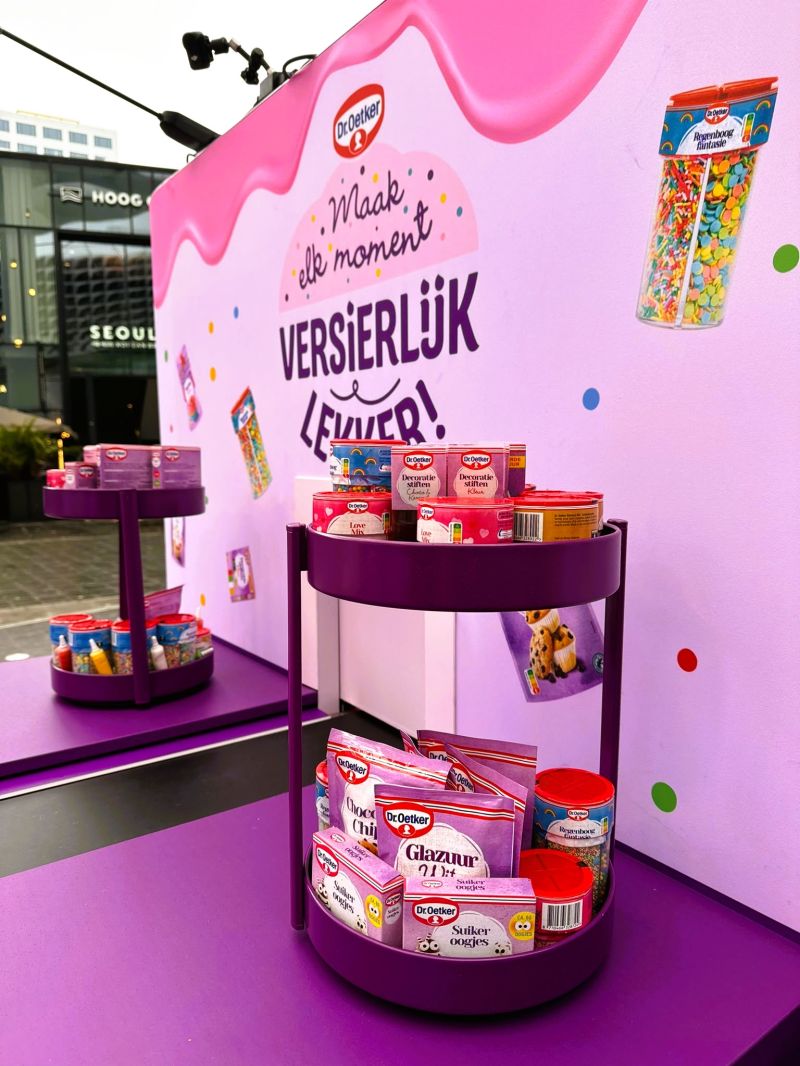
Several months later, Dr. Oetker showed a different approach in Utrecht. At Versierstudio Live in Hoog Catharijne, visitors were not simply handed a cake or cupcake to decorate. A conveyor belt brought out avocados, watermelon, popcorn and Dutch rusks, among other foods. Participants decorated their creations with icing, sprinkles and other toppings.
Then came a twist. The decorated creations went to a photo studio, where they were photographed alongside the maker’s name. Shortly afterwards, the pictures appeared on large digital advertising screens in and around Utrecht Central Station.
From personal creation to public campaign moment
Dr. Oetker demonstrates how decorating something can become a public-facing brand activation. You can also view Dr. Oetker Netherlands’ original LinkedIn post.
Marketing Report says hundreds of visitors took part in the two-day activation. The aim was to show how Dr. Oetker’s decorating products could be used beyond conventional baking. Dr. Oetker focused on making something and seeing it displayed; LEGO put the handmade object itself at the centre.
Both examples show how a brand can give visitors an active role. Rather than just looking at a product or receiving a message, people get to make choices and create something. The way people interact with brands also features in other original promotional product ideas.
4 giveaway ideas visitors can finish themselves
A creative giveaway does not have to be complicated. A cotton bag and a few fabric pens may be enough. Other ideas need more planning: printing T-shirts on site requires equipment, while a building kit needs time and table space. You can order the base product beforehand and let visitors add their own finishing touch at the event.
A tote bag visitors decorate themselves
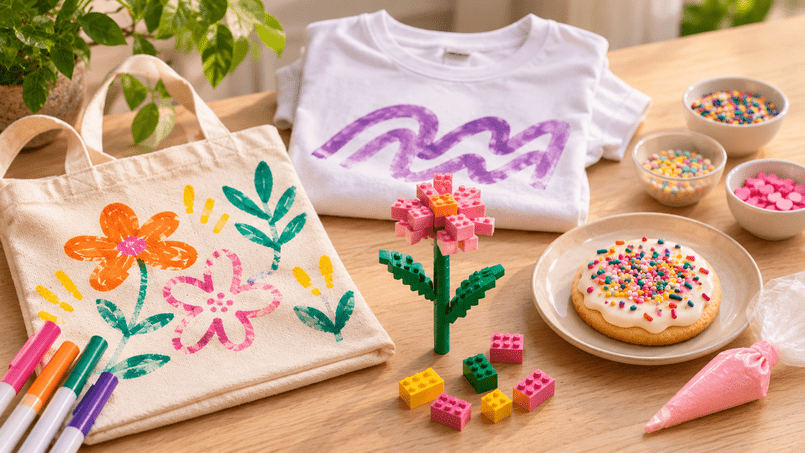
A cotton tote might not be the first thing that comes to mind when you think of creative giveaways. That is exactly why it is interesting to leave it unfinished. Put a stack of lightweight cotton bags on the table, add fabric pens and invite visitors to draw their initials, a pattern or something inspired by the event.
A small company logo can be printed on the bag beforehand, leaving plenty of room for the visitor’s design. Loopper offers printed trade show bags in a range of cotton styles. One reviewed 100 g/m² bag was listed at €1.86 each for 250 units.
Fabric pens are not automatically included. Some inks need heat-setting with an iron before they become wash-resistant. If you prefer a different style of shopper, explore the range of printed bags .
A T-shirt with a design visitors choose
Not everyone wants to spend time drawing. Sometimes a choice of four or five designs is enough. Visitors select a print, perhaps adding a name or small graphic. A staff member then applies it to the shirt using a suitable transfer and heat press.
Everyone ends up with their own version of the same merchandise. At Loopper, you can order printed T-shirts, perhaps with a small logo on the chest or back of the neck. Individual on-site printing requires a separate setup; it is not automatically included in standard print services.
You will need a range of sizes, a safe area for the heat press and a trained operator. Test the transfer on the chosen fabric beforehand. Visitors then do more than pick a shirt: they see their own version being made.
A small LEGO model visitors build themselves
The Bloom Bar showed how building can be part of a brand activation. A smaller-scale version could use a kit inspired by a familiar product, a simple object in brand colours or a campaign theme. Visitors assemble it themselves, following an instruction card.
Loopper lists personalised LEGO sets in several formats. The models reviewed start at 250 units, with prices on request and a stated lead time of 40 working days. Confirm the available builds, packaging and personalisation options before ordering, as well as whether the kit is suitable for an on-site activity.
An edible giveaway visitors decorate themselves
A DIY giveaway does not have to last for years. It might be something visitors eat on the spot. Inspired by Dr. Oetker, you could offer a biscuit or cookie to decorate with icing and toppings, perhaps in your brand colours.
Pre-printed packaging or a branded card can connect the activity to the brand. Loopper also offers personalised food gifts and other promotional materials, but that does not mean those products are suitable for live decorating. The base food, toppings, hygiene arrangements and allergen information must be organised separately.
The distinction from the first three ideas is clear: a biscuit is not a lasting keepsake. The making experience is the point. At festival-style events, suitable festival accessories can support the wider activity.
How much does a make-your-own giveaway cost?
A cotton bag may cost only a couple of euros. A table stocked with fabric pens, staff support and room to draw costs more. When visitors finish their own giveaways, the unit price is only one part of the budget. Materials and delivery vary considerably between activities.
Four ideas, four different setups
| Giveaway | Example base product price | Additional requirements | Time per visitor* |
|---|---|---|---|
| Cotton tote bag (100 g/m²) | €1.86 per unit | Fabric pens, tables, possible heat-setting | 5–10 min |
| T-shirt (180 g/m²) | €2.04 per unit | Transfers, heat press, trained operator | 6–10 min |
| LEGO kit | Price on request | Building area, instructions, staff support | 8–15 min |
| Edible creation | No suitable base price confirmed | Decorations, hygiene arrangements, staff support | 4–7 min |
*Times are illustrative planning assumptions, not measured averages. The product prices are previously reviewed examples at 250 units, not live quotations or complete workshop costs. The €2.04 T-shirt price has been confirmed for the chosen version; prices may change. Check the final quotation and configuration before ordering.
The unit price is only the starting point
At €1.86 each, 250 cotton bags cost €465 before fabric pens, equipment and staff time. At €2.04 each, 250 T-shirts cost €510 before the extra cost of individual prints, transfers and on-site delivery.
Planning is particularly important for LEGO: the reviewed custom sets have a stated lead time of 40 working days. Food-based activities bring different costs for ingredients, hygiene and packaging. As a suitable product combination has not yet been confirmed, there is no reliable per-person price to quote.
Your real cost per participant becomes clearer when you divide the total activity budget by the number of people who actually take part. You could, for example, combine base products with goodie bags for collection or packaging, where that suits the concept.
How to stop your creative trade show stand becoming a queue
One visitor chooses a design, takes a seat and begins to draw. A few minutes later, three more people are waiting. The activity attracts attention, but suddenly there is no room for anyone else. That is the operational challenge of a make-your-own giveaway.
Plan around participants, not passing footfall
Not everyone who walks past your stand will want to take part. Decide how many people you want to serve and how much time you have. With four stations, eight minutes per participant and assumed utilisation of 75%, a simple model gives approximately 22 completed participants per hour. This is not a guaranteed throughput: timings and visitor flow need to be tested first.
How does activity time affect your stand capacity?
Choose the number of minutes each participant needs. The model assumes four simultaneous activity stations and 75% effective utilisation. The bars compare hypothetical scenarios, not observed performance.
At five minutes per participant, four stations could theoretically accommodate 36 people per hour.
At eight minutes per participant, the model gives 22 completed participants per hour.
At ten minutes per participant, theoretical capacity falls to 18.
At fifteen minutes per participant, four stations could theoretically accommodate 12 people per hour.
Formula: 4 × 60 ÷ minutes × 0.75; rounded down to whole participants per hour. If the CMS does not support CSS :has() the four bars and assumptions remain readable.
Order more than just the giveaway
A box of 250 cotton bags is not an event activity on its own. Use this expandable checklist to prepare your stand.
Materials
Do you have enough bags, shirts, bricks or edible products, including spares for mistakes and test runs?
Activity stations
How many people can make something at once without getting in each other’s way? Is there space for supplies and a queue?
Staff support
Who explains the activity, restocks supplies and helps participants? A heat press requires a trained operator.
Finishing
Does the design need to dry, be heat-set, pressed or packed? Test this before the event, and consider food hygiene where relevant.
Queues and collection
Can visitors start immediately, or would collection times, a smaller design selection or bookable slots work better?
Trial run
Ask someone unfamiliar with the concept to complete one giveaway. That will reveal unclear instructions and the actual time required.
How far ahead should you order?
Lead times depend heavily on the product, quantity and personalisation. Some printed trade show gifts have published turnaround times of a few working days; others take much longer. The personalised LEGO sets reviewed here, for example, have a stated lead time of 40 working days. Confirm delivery for the exact product and share your event date when requesting a quote.
Production time is not the same as preparation time. Approving artwork, sourcing supplies, testing the activity and arranging equipment all take time. If your deadline is close, you can explore trade show giveaways with fast delivery, but the hands-on activity still needs its own planning.
A creative giveaway does not need to take long. More importantly, it should be simple enough to enjoy even at a busy trade show.
What does someone really take home?
By the end of a trade show, a visitor’s bag contains all sorts of things: leaflets, business cards, a pen and perhaps a notebook. Some will be used later. Others will end up in a drawer.
A bag someone has drawn on, or a little model they assembled at the stand, has its own story of how it came to be. The visitor knows not only which brand provided it, but what they did to make it theirs.
That makes hands-on giveaways an interesting alternative to simply handing things out. Not because every visitor wants to spend hours crafting, but because one simple action can turn a standard product into something personal. For brands, the challenge is balancing the visitor experience, budget and available time.
Sources and notes
- LEGO — Botanicals Bloom Bar, information on the Amsterdam activation.
- BizBash — Inside LEGO's Botanicals Bloom Bar Pop-Up in Amsterdam, report and attributed attendance figure.
- Marketing Report — Being There brings Dr. Oetker’s Versierstudio to life, description of the Utrecht activation.


