
You make tea before leaving home. Three hours later, you unscrew your flask and pour a cup that is still hot. Yet the outside of the container feels almost like the room around it. How can something hold on to heat without feeling warm itself?
How does a thermos flask work? It has an inner and outer wall with most of the air removed from the space between them. That vacuum dramatically reduces heat transfer by conduction and convection; reflective surfaces can reduce radiative heat transfer too. An insulated, well-fitting lid limits heat escaping through the opening. The design works in either direction, helping cold drinks stay cold as well.
It is not a source of heat, and it cannot keep a drink at exactly the same temperature indefinitely. Understanding where heat can still travel explains why different flasks perform differently, why a loose stopper makes such a difference and why their advertised times are best treated as a guide.
How does a thermos flask stop heat escaping?
Put hot tea into an ordinary mug and its temperature starts moving towards that of the room. A thermos flask slows that journey by tackling three ways heat moves: conduction, convection and radiation. These are different processes, which is why the vacuum and the flask's surfaces both matter.
| How heat moves | What happens in an ordinary container | What a vacuum flask changes |
|---|---|---|
| Conduction | Heat passes through the material of the cup and anything in contact with it. | The evacuated gap greatly reduces heat transfer between the two walls. Some heat still passes through solid connections, especially around the neck and lid. |
| Convection | Moving air or liquid carries heat from one place to another. | With almost no air between the walls, there is virtually no convection in that gap. The lid limits the exchange of warm and cool air at the opening. |
| Radiation | Surfaces exchange heat through infrared radiation. | Reflective surfaces, where used in the construction, reduce radiant heat transfer across the gap. |
Heat can still escape through the stopper, the bottle's neck and other solid parts. That is why a vacuum flask is an exceptionally effective insulator, not a perfect one. The same design slows heat moving into an iced drink on a hot day.
The clever part isn't adding heat. It's making heat take a much slower route.
What's inside a thermos flask?
Most modern vacuum flasks contain two stainless-steel walls connected at the neck. During manufacture, much of the air between them is removed and the space is sealed. Some flasks use reflective surfaces to further limit heat transfer. The lid, meanwhile, has its own seal and insulation: it closes a point where the two-wall vacuum cannot continue.
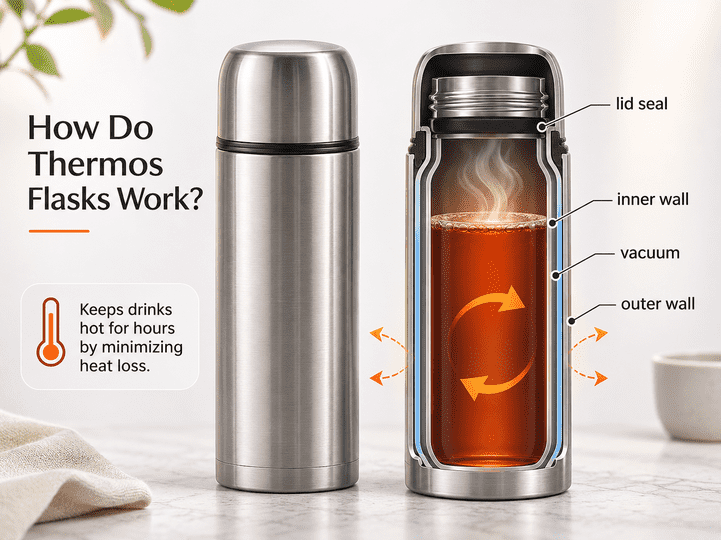
Holds the drink
This is the surface that touches your tea, coffee or cold water. It is usually stainless steel in modern reusable bottles.
Slows heat transfer
Removing the air between the walls prevents air circulation there and greatly reduces conduction through gas.
Closes the weak point
A properly closed lid helps limit air exchange and heat transfer around the opening.
A laboratory invention that found its way into everyday life
The story begins with Scottish scientist James Dewar. In 1892, he developed a vacuum-jacketed flask to keep substances extremely cold during research into liquefied gases. The Royal Institution's surviving example had glass vessels fitted inside one another. By 1904, the idea had been commercialised by the company behind the Thermos name. It was a scientific solution for preserving low temperatures before it became a familiar way of keeping tea hot.
Glass-lined flasks still exist, but stainless steel is generally better suited to everyday knocks. A vacuum flask can, however, lose effectiveness if damage compromises its sealed insulating gap.
How long does a thermos flask keep drinks hot?
There is no single answer. Some insulated cups are designed for a short commute; other double-walled bottles aim to keep drinks hot for many hours. Size, lid construction, the starting temperature of the drink, outside temperature, fill level and how often you open the flask all influence the result.
To make that difference tangible, here are three stated performance claims from Loopper's international product listings, checked on 18 November 2026. These are descriptions on the product pages, not independently verified laboratory results or guarantees of what every user will experience.
Three designs, three different claims
Stainless steel and plastic; listed as 2h hot.
Stainless steel; listed as 8h hot and 24h cold.
Push-top mechanism; listed as Hot for 12 hours.
Source: Loopper.com travel mugs category; product descriptions accessed 18 November 2026. Actual temperature retention depends on conditions. Recheck the live product pages before publishing.
The comparison is useful precisely because the figures are not interchangeable. The first is a small insulated mug; the second quotes separate hot and cold performance; and the third describes a specific tumbler with a push-top lid. Do not assume every thermos flask, or even every item made from stainless steel, will achieve the longest figure.
If you are choosing between formats, compare the intended use: personalized thermos flasks for carrying a drink over longer periods, thermos cups for a desk or short trip, and travel mugs for easy sipping on the move. Those are practical distinctions, not performance guarantees.
How can you keep drinks hot for longer?
A little preparation helps the insulation do its job. Start by reading the manufacturer's care and temperature instructions: not every container is intended for boiling liquids, and some drinking lids need extra caution with hot drinks.
- 1
Pre-warm carefully
Where the maker allows it, warm the interior with hot water, empty it, then add your drink. Avoid assuming boiling water is suitable for every model.
- 2
Use a sensible fill level
Fill close to the recommended maximum without overfilling. Leaving a very large air space means less warm liquid inside to retain heat.
- 3
Keep the lid closed
Open only when needed and fasten the stopper correctly. Repeatedly opening a flask lets heat escape through its least insulated point.
Look after the seal and the finish
Wash the bottle and the removable parts as directed by the manufacturer, and allow them to dry fully before storage. Never put a metal flask in the microwave. Dishwasher suitability depends on the particular design and finish, including printed branding. If the outside of an intact vacuum flask becomes unusually hot when filled with a hot drink, or its performance drops sharply, inspect it and consult the maker rather than assuming every small dent has destroyed the vacuum.
For a business, that last point is relevant beyond the physics. A flask selected for employees who travel or work outdoors needs to be comfortable to carry, easy to open and suitable for its intended drink. A personalized thermos flask can become something a person reaches for repeatedly when its design fits the routine. A carefully chosen printed or engraved finish should follow the supplier's care guidance so the branding remains presentable.
The best flask is not the one with the biggest number on the listing. It's the one whose insulation, lid and daily use match the way its owner actually drinks.
More to explore



Marketing team, Loopper
Exploring the use, design and practical details behind everyday promotional products.
Connect with Wissam on LinkedIn
 Content reviewed by Lars Rud, Marketing Manager at Loopper


